
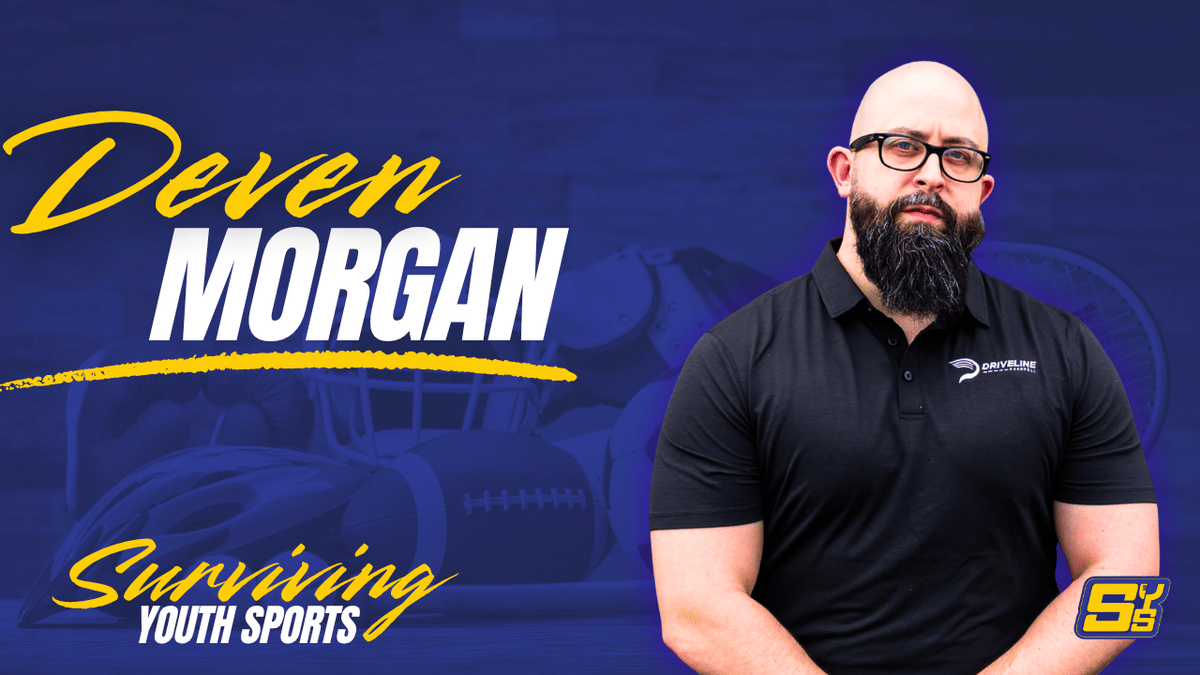
In this episode of Surviving Youth Sports, Rhett sits down with Deven Morgan, Director of Youth Baseball at Driveline Baseball, to talk about the realities of development, overuse, and parenting inside modern baseball.
Deven brings a rare perspective. He is a coach, a father, and someone working inside one of the most data-driven baseball environments in the country. But this conversation is not just about velocity, training tools, or analytics. It is about what happens when kids are pushed into systems that reward outcomes before development.
Rhett and Deven talk honestly about pitch counts, tournament pressure, multi-sport athletes, overuse injuries, and why the youth baseball world needs better communication before more kids get hurt or walk away from the game entirely.
Subscribe
Apple Podcasts
Spotify
YouTube
Guest Resources
Email mentioned in episode: deven@drivelinebaseball.com
Key Takeaways
Kids are not small adults, and their training should not copy what professional athletes do.
The pressure to win youth tournaments often creates decisions that do not serve long-term development.
Multi-sport participation can give kids movement skills, recovery time, and a healthier relationship with baseball.
Pitch counts only work if leagues, tournaments, and teams are communicating with each other.
The real value of sports may not be the trophy, but the process kids learn while chasing something hard.
Soundbites
“Kids are not small adults.”
“It’s not about learning and it’s not about development, it’s about validation.”
“The kids who are good enough to get overused are the ones most likely to get overused.”
“The process stuff is the stuff that’s primary.”
“He’s my favorite player and he always will be.”
“Everyone agrees overuse is a problem. So why are we still making it so easy for it to happen?”
“If you show me a kid that’s competitive on a soccer field, I’ll show you a competitive shortstop.”
“You probably should hate baseball a little bit. It’s a game that’s going to make you feel bad.”
“There is a generation of parents coming that may decide this isn’t worth it.”
Episode Breakdown with Timestamps
Watch on YouTube or Listen on Apple or Spotify and follow along
[00:23] Meeting Deven Morgan
Rhett introduces Deven as a youth sports advocate, Driveline leader, and father.
Deven shares that his life revolves around baseball, family, and trying to survive the youth sports experience.
The episode starts with the reality that sports families live inside constant movement, pressure, and sacrifice.
[01:04] The Partner Behind the Sports Life
Rhett and Deven talk about how hard sports work can be on families.
Deven explains how his wife supported his career change into Driveline.
The conversation highlights an often overlooked truth: youth sports careers and coaching lives impact the whole household.
[05:16] From Parent to Driveline
Deven shares how coaching his own kids pulled him back into baseball.
He reflects on leaving the game as a teenager and later trying to understand how to help his kids develop.
His path into Driveline started with curiosity, research, and a desire to learn.
[08:51] There Is No One Perfect Baseball System
Rhett raises the tension around Driveline and how some people love it while others push back.
Deven explains that athletic development is evergreen, but athletes still need individualized paths.
The conversation challenges the idea that one method works for every kid.
[15:10] Analytics, Feel, and Coaching Humans
Deven explains that good coaching requires both data and human understanding.
For younger athletes, he keeps analytics simple: throw harder, hit harder, and grow stronger in a healthy way.
Rhett adds that some players cannot handle analytical feedback during games and need a different message in the moment.
[20:00] Using Training Tools the Right Way
Deven talks about why Driveline puts out free resources and why details matter.
He explains that tools like plyo balls can be helpful when used appropriately.
The bigger warning is clear: copying a professional player’s program for an 11-year-old can be dangerous.
[24:01] Why Multi-Sport Athletes Matter
Rhett and Deven discuss the value of kids playing multiple sports.
Deven explains how soccer, basketball, and other sports help kids develop movement solutions baseball alone may not provide.
This section challenges early specialization and reminds parents that athleticism is broader than one sport.
[30:12] Playing at the Right Level
Rhett talks about the pressure to play higher-level tournaments too early.
Deven agrees that kids need competitive environments that challenge them without crushing them.
They discuss how being blown out every weekend can damage confidence and love for the game.
[34:38] The Pitch Count Problem
Deven lays out his work toward universal pitch counts and universal reporting.
He explains the issue with kids pitching in Little League during the week and tournaments on the weekend with no shared tracking.
The goal is not to hurt tournament businesses, but to protect kids and the future of the sport.
[40:35] When Winning Becomes Validation
Deven talks about how some youth baseball environments are built around trophies, plastic rings, and adult validation.
Rhett connects the issue to other sports, where cost, pressure, and exposure culture are also growing.
The conversation points to a bigger cultural problem: families are paying more, traveling more, and sometimes losing sight of why kids started playing.
[44:40] Building Workload the Right Way
Deven shares a story about managing his own son’s pitching workload during Little League All-Stars.
He explains the difference between building capacity over time and creating sudden workload spikes.
Rhett shares how he manages pitch counts with his own team, even if it means losing a game.
[50:30] Process Over Plastic
Deven reflects on his son’s future and the uncertainty of whether baseball will continue at the college or professional level.
His focus is not only on baseball outcomes, but on whether his son learns process, discipline, and fulfillment.
The episode closes with the reminder that trophies often disappear, but the way kids learn to pursue something can stay with them.
Final Reflection
This episode sits in the tension most sports families know well.
We want our kids to compete. We want them to improve. We want them to chase hard things. But somewhere along the way, the system can make it feel like every weekend, every pitch, and every tournament has to prove something.
Maybe the better question is not, “How far can this take my kid?”
Maybe it is, “What is this experience teaching them along the way?”
Call to Action
Subscribe and follow Surviving Youth Sports for more honest conversations about parenting, coaching, development, and the pressure families feel inside modern youth sports.
Share this episode with a parent, coach, or baseball family trying to navigate pitch counts, tournament pressure, and the long road of development.

Alyson Stemas: Parents Aren’t Crazy. They’re Uninformed.
Parents get called “crazy” in youth sports all the time. But what if a lot of that behavior comes from parents trying to navigate a system they don’t fully understand? Former competitive figure skater and youth sports parent Alyson Stemas joins Rhett to talk about raising a competitive young golfer,...

Bill Hoopes: Parents Are Losing Themselves in Youth Sports
Parents spend years driving to practices, sitting through tournaments, paying for lessons, and helping their kids chase their dreams. But somewhere along the way, how many parents start losing themselves in the process? Bill Hoopes, longtime softball coach, tournament director, author, and founder o...

Morgan Schill: Expectations Can Steal the Joy of Youth Sports
Expectations can inspire young athletes. They can also quietly steal the joy that made them fall in love with sports in the first place. Most parents don’t set out to create pressure. They simply want what’s best for their kids. But when winning, rankings, playing time, scholarships, or even the mon...

Craig Bishop: What Parents Say They Want vs. What They Actually Chase
Craig Bishop: What Parents Say They Want vs. What They Actually Chase What do parents really want from youth sports? Most of us would say development. But when the pressure of competition sets in, do our decisions tell a different story? In this episode, Rhett Parker sits down with longtime coach, p...

Breanne Smedley: The Pressure of Being a Girl in Sports
Girls are quitting sports at twice the rate of boys by age 13 , and it’s not because they don’t love the game. In this episode of Surviving Youth Sports , Rhett Parker sits down with Coach Breanne Smedley , former collegiate volleyball player, high school coach, mental performance coach, and founder...

Jonathan Carone: Are Your Kid’s Sports Really About Them?
What if the pressure we feel in youth sports has less to do with our kids and more to do with ourselves? In this episode, Rhett Parker sits down with Jonathan Carone, founder of Healthy Sports Parents, for an honest conversation about the hidden emotions that shape so many youth sports decisions. Fr...

Lindsey Nadler: Why Kids Need More Freedom and Less Monitoring
Lindsey Nadler knows what it’s like when sports become your entire identity. A former Division I softball player turned mental performance coach, Lindsey joins Rhett Parker for a conversation about the pressures facing today’s athletes and why many kids are carrying more stress than ever before. Fro...

Bobby Minor: The Cost of Chasing the Dream
What is the youth sports dream really costing families? In this episode of Surviving Youth Sports, Rhett Parker sits down with Bobby Minor, a former Division I player, coach, recruiting evaluator, organization director, and father who has spent decades around the game of baseball. Together, they unp...

Justin Furtado: Are Parents Protecting Kids Too Much? Lessons, Failure, and Playing Time
Justin Furtado, founder of BTG Basketball and host of Beyond the Scoreboard , joins Rhett for an honest conversation about one of the most uncomfortable parts of youth sports: not playing. From playing time battles to overinvolved parents, Justin and Rhett explore how the lessons kids learn through ...