
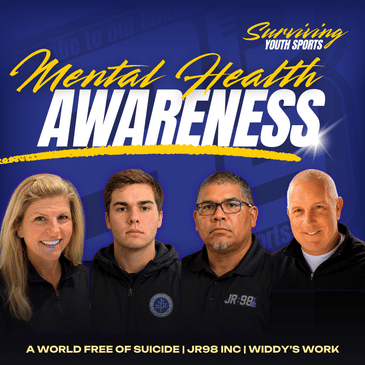
This episode is one of the most important conversations we’ve had on Surviving Youth Sports.
Rhett sits down with Carson Leiden from A World Free of Suicide, Corey and Kelly Widman from Widdy’s Work, and Carlos Ramirez from JR98 Inc. to talk about mental health, suicide prevention, pressure, identity, grief, and the realities many athletes and families quietly carry.
The conversation explores how social media, comparison culture, performance expectations, and the pressure to “make it” can impact young athletes mentally and emotionally. More importantly, it highlights why creating safe, honest conversations around mental health matters so much for kids, parents, coaches, and communities.
This is not an easy conversation. But it’s an important one.
If you or someone you know is struggling, call or text 988.
[00:00:00] I ended up throwing it in the dress. All that matters is like really getting better in the now. Okay, let's go. Welcome to Surviving Youth Sports Podcast, where we dive into real stories behind the wins, the losses, and the lessons that come with raising, coaching, and being young athletes. Now let's get into it.
[00:00:22] Hi, and welcome to another episode of Surviving Youth Sports. I'm your host, Rhett Parker. And today, very special moment, I think, definitely for myself, but sort of a different subject, one that is difficult to talk about.
[00:00:41] And it's mental health awareness and suicide. And, you know, we have a panel of people that I know personally and are doing some really great things, especially as it pertains to youth sports and mental health. And I'm excited to have everybody on this call.
[00:00:57] So I think what we're going to do first panel, so it's a little amateur hour for me, maybe, but let's go around the room and introduce yourselves and give us a little background. Carson, tell us a little bit about yourself and background on some of the things you're doing.
[00:01:13] Yeah, so my name is Carson Lydon. Right now, I'm a first year law student at Willamette University. And in the, you know, spare time, I run a world free of suicide, which is a 501c3 nonprofit. I created it back in 2018, after losing a friend to suicide and struggling myself with some mental health issues. Basically, our whole goal is just to educate and advocate for suicide prevention and make this world one day free of suicide.
[00:01:40] And a former player of mine, too, which is makes me makes me happy that you're doing all these great things. So we have Kelly and Corey, Corey Whitman. And this is my wife, Kelly. And we created a Witte's work in 2023 after losing our son, Reese. He died by suicide, a big baseball guy in the community, Silicon new level. And we also share Carson's goal is to
[00:02:10] advocate and to advocate and to hopefully get rid of the stigma surrounding this word and this, this terrible disease and, you know, let let these young, young athletes and young adults know that it's okay to seek help and get help.
[00:02:27] Absolutely. And also went on a Northwest elite trip or two in there and played in tournaments of mine. And I, I, I, I, yeah, it's, this is, this is huge for me. I love getting people together that I obviously have relationships with and backstories.
[00:02:45] And so Carson, you know, start with you. Tell us the moment where you really give us more background on, on what, when you started the foundation and just the, the, the real why behind it. Yeah. Well, really it was, I was sitting in my eighth grade English class and I got called down to the principal's office and my mom was there. And, uh, they told me that my friend had died by suicide.
[00:03:09] Uh, that was the first time I ever heard the word suicide actually before I had no clue what it was. Um, and basically for about two or three months after that, I kind of turned into like a shell turtle. Um, didn't really know what was going on. Didn't really know what to do. Um, and then one day really, I was just searching for like tools to help myself, honestly.
[00:03:31] And, uh, I came across, um, some volunteer events and like, uh, American foundation for suicide prevention in specific had a, um, out of darkness walk. So I decided to do the walk. Um, I made a team in honor of my friend and that first year, which was, um, 2017, um, we raised $5,000 and I had about a hundred people in attendance.
[00:03:55] So after that, I kind of just felt super inspired that instead of me kind of drawing in my own sorrow and sadness, I may as well just try to help people. Um, a, because it kind of made me feel better about my mental side of things. And B, I just didn't want anyone to really feel the way my friend felt, uh, when he passed away. So really since then, it's just been about inspiring communities, um, bringing communities together. And then honestly, just making mental health, uh, conversation for the forefront.
[00:04:24] Um, our biggest thing is like the physical side of things is so talked about in this world, but the mental aspect is just as important, if not more important. So. Absolutely. Absolutely. And I, I, uh, as a, as a youth sports parent, parent in general, I'm with you. I mean, we have to talk about these things with our kids, even if they're uncomfortable for us.
[00:04:49] And I, I know that, uh, you know, Corey and Kelly, um, obviously you're very similar to, to, to Carson. And, and, um, what, what drove you guys to, to start the, um, you know, the, the, the moment where you're like, we need to go talk about this with people. Talk to us about that.
[00:05:11] I think it was pretty immediate that we realized that, um, Reese left us a message to help people. He, um, in his final text to me and Corey, he said, help as many people as you can, um, try to help people not harm themselves. Try to help this, prevent this from happening to others.
[00:05:33] And he then also left a note to his baseball, um, brothers, his friends, um, to do what he couldn't do and get help. And we realized those words are so powerful and that we couldn't do nothing. And part of the therapy for us in our grief is to, um, help other people and to share Reese's message and his words.
[00:05:58] Um, because beyond the baseball field, he was also just such a wonderful person that had so, it touched so many lives, young and old, his teachers, his friends, his community. And, um, with that, with those words and pictures of him on the field, off the field, laughing, um, smiling, just, we can, we can make a difference. We, we can make a difference.
[00:06:22] And there's days that we feel like, how do we do one more thing? Just because it's so exhausting sometimes to keep, keep doing these efforts. But then we'll get a message from somebody saying your, your words, your son's words, or what you said helped this person that I know. And then we're, we realize, okay, we can, we can do this. We can keep doing this.
[00:06:48] We will do this in Reese's memory in honor of him and to continue his legacy. Absolutely. And, and yeah, he, every time I saw him at the field, he always had a smile on his face and all the new level guys. And, and I, I, it, it, even if you, I, even if you help one person, it's all worth it. That's the way I look at it.
[00:07:11] Even, even obviously this is a very touchy and, and very sensitive subject, which we're trying to get over that. Right. But podcast is meant to do the same thing. Maybe it's something as simple as talking to your coach or playing time or whatever, but we're just trying to help people. And I think it's so important for people to have that as their message, helping people. Cause there's not as much of that as we need. And Carlos, welcome back.
[00:07:40] Tell us about your foundation a little bit. You know, it looks like you're in the dugout right now. So that's great. And, and tell us how, you know, what you got going on with the, with the foundation and, and, and how, how it started. Of course, of course, uh, JR98 is a foundation. It's a nonprofit organization. Uh, of course, you know, we're back by MLB.
[00:08:00] My son, Ramirez, he was the, uh, open catcher slash, uh, catching coordinator for the Tampa Bay Rays, uh, with the big league club. We lost Jim due to suicide back in 2022. That's how we started the foundation. That's how the name came up. His number was 98. Uh, really, really, we didn't know how many, how many people loved him. Uh, uh, of course, it was all throughout MLB.
[00:08:27] Of course, my friends, uh, just like yourself, uh, a lot of friends that we had was at the moment. I was, uh, coaching the Hawaii Pacific, uh, when it happened. So the flight back was, seemed like a, like an eternity. It was an eight hour flight. It seemed like it was like 24 hours flight. Uh, really, really, really, uh, good kid.
[00:08:51] A lot of friends, uh, not just through our MLB, but also, you know, collegiate. He played for Arkansas. Then Illinois State. Uh, you know, really talented, uh, baseball mind, right? He had a lot of opportunities. Uh, some people say that he was the next, uh, uh, big, one of the biggest minds in baseball, in MLB. Uh, we didn't know anything that he was struggling. We didn't see any signs.
[00:09:21] I got to see him the night before, even the morning before. And then two hours after, it just happened. JR 98, of course, is a non-profit organization. We go around the nation. You know, we do mental health, uh, talks, suicide prevention. We have a, uh, uh, ambassador program.
[00:09:40] So we have ambassadors just about every corner in the, uh, in the States and Puerto Rico, uh, Dominican Republic, uh, Venezuela, uh, just about, uh, even Japan as well. Uh, uh, uh, we also have a scholarship program, uh, that we give, uh, scholarships to, uh, those, those that are, that people might call it a suicide survivors. Uh, uh, you know, immediate family of, uh, uh, suicide victims.
[00:10:08] Uh, so we award, this year, we award intense scholarships, uh, to, to, whether it's going to be, uh, uh, parents, uh, grandparents, uh, brothers, sisters, uh, immediate family. Uh, and, and, and we also have a team of doctors as well. Uh, we have the, uh, NFL, uh, psychologists, uh, uh, Mario Soto, which is probably known in New York. They, as well, it's, it's part of our JR 98 program.
[00:10:37] Uh, MLB, uh, psychiatrists and doctors are, are part of JR 98 as well. So we try to facilitate, we try to facilitate whoever is in, put them in contact for, uh, with whoever needs it. I said this right before we got on my 12 year old son driving him to his little league pictures yesterday. And, and he's, Oh, who's on the podcast next?
[00:11:03] And I, and I tell him, and I was like, well, we're going to, we're going to talk about suicide. And his eye, sixth grader, his eyes are like, Oh my, oh my gosh. And I'm like, no, no, no, no. Like this is good. Like we, if you're struggling, we have to talk about it. Right. Like we're, that's the message we're trying to say to our kids. Like it's okay. Yes. Suicide. But, but it really hit me. Like, it's a scary word for a 12 year old sixth grader. It's a scary word for a lot of people.
[00:11:32] So how do we, and we let's start with, with, uh, uh, the women's how, how do we, how do I say that to my third grader in a couple of years? Like we don't want to throw too much at an eight year old right now, but like, how do we have that conversation where it's like, Hey, it's okay to be open and talk about this. Well, well, that's just it. I mean, we, we have to be open and talk about this because, uh, since Reese has passed and,
[00:12:01] uh, I'm sure Carson's friend is just like Reese and Jean probably very outgoing and very, uh, uh, looked like he had everything ahead of them. But, uh, the brain is no different than any other organ in the body. Uh, sometimes people need help. And, uh, like you said, or like we're talking about right now, talking about it and letting people know that, Hey, it is okay. If you, if you discuss it, it doesn't mean that you're more likely to do it.
[00:12:29] It's just something that, you know, young people and, well, I mean, people in general need to be aware of that, uh, that sometimes, you know, people are fighting battles that you can't see, you know, smile on their face, uh, alpha males going about their business. But I think the sooner that we talk about it better. And, and I would say this, like one of the things that I do in my talks is I tell people, Hey, you know, Reese didn't want these issues just like somebody with cancer doesn't want
[00:12:58] cancer or Alzheimer's wants that disease. Sometimes it's, uh, it's, it's pretty unpreventable, but, uh, being open and honest about mental health issues with others and making it okay to talk about and not stigmatizing when you do need help. That's going to, that's going to help people in the future. In my opinion. I mean, uh, since Reese has been gone, I've been very open and honest with people about
[00:13:27] my feelings and my struggles. And, uh, I mean, it's still like them and Pierce, you know, uh, uh, I I'm very vulnerable with the guys very, Hey man, I'm doing well today. And, uh, some days let them know I'm, I'm, I miss Reese. I'm not doing very good and it's okay. You know, it's, uh, I want the guys to see a, uh, 50 year old man, you know, go, go through some emotions and, and be vulnerable. Yeah. Yeah. And I think it is hard.
[00:13:55] Like it is hard to have those conversations with the younger, um, middle school, um, school age kids because you don't want to overwhelm them. But at the same time to start that dialogue of, you know, if you're feeling so sad that you feel like you don't want to get up out of bed, like, let's talk about that. Like, how are you feeling? Um, because talking to early, um, elementary educators, they have kids that their knee jerk reaction when they're frustrated is I'm going to go kill myself.
[00:14:25] And it's like, Oh dear. Like that, how is that the first? And I don't think they're literally going to do that, but that's their knee jerk response. And it's like, Oh, let's, let's talk about that. Like, let's talk about what that means and the finality of that. And what are other ways that we can do to cope to get through this problem? What do you think, Carson? I mean, I think the, uh, the biggest thing starts with education, um, getting the specific and right programs into each one of these schools.
[00:14:54] It's actually going to teach these kids from an early age. I think, you know, uh, as someone in the Oregon school districts, uh, I never learned about mental health even throughout high school. Um, you know, I learned about sexual education and I learned about all that kind of stuff in the health class, but I never learned about the, uh, the mental side of things really. So I think that honestly, the first step in a lot of this is just educating the youth. And that obviously is going to come through the schools, um, come through community events
[00:15:23] and stuff like that. But I also think just like teaching kids that, um, emotional awareness is okay. Um, being able to ask for help if that's from your parent, um, a friend or even a teacher. Coach. Yeah, coach. Um, and I think honestly, just like learning, um, really just how to like support others in a way that's, that's not just, uh, oh, congrats. You did this.
[00:15:48] It's a genuine support system, uh, feeling like every person around you is more like a family and a brotherhood than just, uh, another person right next to you. So Carlos. Of course, man. And not only the first step starts, not just a school. I mean, we have, we have had, uh, we do these talks at a, at the elementary level, uh, uh, all the way to the professional level.
[00:16:14] You'll be surprised, you know, how many kids go through mental health when they're eight, nine, 10 years old. You know, it's, it's really, really surprising, uh, when you see that, right? Uh, uh, and it's not just school, but it starts at home as well. We have to be able, we as parents have to be able to listen, have that talk. And if you don't have that, that, that talk at home, then the kid is going to run somewhere else and get that information from somewhere else as well, which what is going to be, uh,
[00:16:43] uh, usually they try to relate to the better friends or the, the, the, the closest person that they have. Sometimes we just got to sit down and listen, don't ask questions, just listen. Yeah. And it's, it's not, it's not easy and, and it's not easy to detect. It's not easy to have these conversations. And you just said something, you elementary to professional level.
[00:17:11] And I am going to go off something that just happened within the last little bit here. Okay. And it has to do with social media. Uh, so it was like my little brother, J.R. Ritchie just got called up to the Braves. And so went out to DC, saw him throw, he pitched last night and just, I want to see if like, there was news about like him getting sent down or cause he, cause I hadn't heard from him and they were debating.
[00:17:41] Well, I, I, I go on there and it's, it's gamblers like pissed that he didn't strike out five people and like calling them names. And you're like, and so what happens, right. And it happens at the high school level happens at the college level, the pro level, but, but to sit there and like, and, and it had fairly close with another big league guy, like, but it's all the time. And I'm just sitting there like, man, it's really weird when somebody who's like family
[00:18:08] to you is like, I mean, sort of getting berated on there. I can't imagine what's going to happen to me as a bad start. I mean, people are just going to lose their minds and not think he's human. And it kind of scared me. Oh my God. I didn't have social media. Carson, you did Carlos, you know, Kelly court. We didn't have social media. How much pressure is on these guys? And I say guys like guys and gals, like from what, you know, 14, 13, all the way up through
[00:18:36] the professional, might as well not have it. Right. Right. Carlos go, go into that. Corey, go ahead, Corey. Yeah. Well, a couple of years ago, King five did a research and interview with UW. UW had a study they put out and it said suicide rates among college athletes have doubled in the last 20 years. And I'll bet you since those two years that we did this interview that it's gone up.
[00:19:05] And we had found out that in the, at the high school level, it's gone up. Now I want to say this, like baseball was Reese's sanctuary. He, he absolutely loved baseball. Unfortunately, Reese was also epileptic as well. And we think that, uh, the diagnosis of that, and then some of the medication that he was on didn't help him. Social media is a huge, huge factor. And I'll just give you a Reese did very well in a tournament, a showcase tournament one time
[00:19:32] and the tournament that he played for, Hey, Reese Widman, uncommitted complete game, whatever. Right. A lot of likes another kid who is, I think at the time committed to Oregon didn't do very well. And they're promoting this kid on their social media as well, which you're supposed to. Right. And then I start looking at the comments and you have 38, 39, 40 year old guys that have nothing to do with baseball, making comments on a 16 year old kid's performance at a tournament
[00:20:01] that ultimately isn't going to matter in the future. But I thought to myself, man, is this guy a coach? Is he a scout? You know, why is he talking about a 16 year old kid like this? And, and I'm not going to, I mean, the kid saw it, but you're right. We didn't have social media growing up. So when we left school, you were off for the day. When these guys leave school, guys and gals, they're always on there.
[00:20:26] They're never disconnected from, from the phone and from the, uh, uh, the, the criticism and ridicule at times that high school and college athletes get, I mean, social media can be a great tool like today. But, uh, yeah, that was one of the things that they pointed out in their study was a social media was the, the, one of the biggest factors, you know, it, I mean, I think, and my producer
[00:20:53] here, I mean, we're getting trolled a little bit on some stuff and, and I never really had social media up until a couple of years ago. So the, one of the interviews we did and people make fun of us and I'm like, what I go. And it went viral. And I was like, Mac, this is of all the good stuff we've done. This is what people want to focus on. I laughed. I was like, this is insane. This is insanity. Um, and so Carson, you did grow up in the social media world.
[00:21:21] Cause I distinctly remember you going to, with us to Arizona in a really big tournament and like throwing like a no hitter or CG shutout or something. And we promoted you, uh, on one of our social medias. You've lived. I mean, give us your perspective. I honestly, yeah. I mean, social media is the best thing in the world and the worst thing in the world. Um, yeah. Like, like you guys said, this, this stuff gets, you know, expressed and put out there,
[00:21:48] but also like, it's the biggest, uh, comparison tool, uh, for kids nowadays. And the, the worst ways, uh, I even remember like, you know, I was a guy, I was committed to Oregon. I was a decent baseball player in high school and I was still, you know, scrolling through Instagram to find the guys that were better than me that I could compare against, you know, or I see a guy that, uh, you see nowadays, you see an eighth grader and ninth grader throwing a 91 miles per hour.
[00:22:17] And then, uh, the ninth grader in, uh, your travel ball program is now going to be like, oh, well I suck at baseball now because I don't throw that just like that one person. So I think that like the biggest thing that I've just noticed throughout social media is like, there's always a comparison aspect to it. Um, you can never be like satisfied with just like what's going on with yourself. You always have to hunt the next light. You always have to hunt the retweet. You always have to hunt the follow.
[00:22:43] Like that's just kind of what our society has kind of grown up into with this, the social media aspect. And like, I still fall into that trap myself. Like I still compare myself against people all the time. So it's just like, I think the most important thing is like, obviously what you see on social media is about the 1% of most of those people's lives. I'm not posting the 99% of times that I'm maybe not feeling a certain way. I'm especially not posting when I'm feeling down.
[00:23:13] Um, the only time I'm really going to be posting is when I'm feeling 110%. So it's just, it's hard to, uh, get a grasp on things and kind of understand where you might be at in life. If you continue and continue and continue to see everyone's best when really that is never the reality. And you just said it, a lot of it's not real. I mean, it's just, it's just not, it's fake and focus on making an impact for your life.
[00:23:40] And if you do that and you impact other people around you, that'll impact and impact and impact. And we really started this granular level. And that's why I love what all you guys are doing. And Carlos, you're a college coach, you know, you have to be on social media. Oh, a hundred percent social media. We have to do that. It's just the tendency that has been going on for the last few years. Right. Uh, uh, it's, it's sometimes we don't have the time to get out, uh, and, and recruit
[00:24:10] a kid, but we want to know how, how he's doing and all that. But, uh, the main thing, yeah, you, you guys touched the issue there of social media is used 99.9% of the time is used for comparison. Okay. And sometimes comparing you to, to the skill level to, and this doesn't have to do with baseball. It could be on any sport.
[00:24:35] Uh, it's, it's used more by comparison or, or getting more lights or getting more, more, more attention, trying to draw more attention, but, but also, uh, understand that, that, you know, the mental health, usually when you, when you fall into a mental health, health crisis, uh, it's a combination of things. It's not, it's not just one thing. It could be, it could be a multiple things. And usually it is multiple things, whether it's going to be an injury, whether it's going
[00:25:02] to be grace, whether it's going to be, uh, loving relationships, whether it's going to be, uh, problems at home, economical problems, you know, you name it. It's, it's a lot of things that I can go down, uh, drugs, uh, drug abuse, uh, abuse or, or alcohol, all that stuff. It could lead to a mental health crisis, but social media, uh, to me, it's a little bit
[00:25:26] more of a peer pressure, uh, thing, uh, that drives other people to do stuff that they're not supposed to. And two, two, sixth graders, we have a bark phone. Most people don't even know what that is. There's no social media. There's no apps. There's like eight numbers in there. You don't need to have it.
[00:25:51] And, and the brain, and I think multiple people here have talked about the brain. I look at a 12 year old brain and a 15 year old brain, even an 18 year old brain, they're very different and they can handle different things. And my wife and I are firm believers of that in terms of middle school. You don't need all the bells and whistles on, on your phone. You don't, you know, you're not getting recruited at 12, not anymore.
[00:26:18] You, you need to call mom to pick you up and you can reach out to your grandparents. That's, that's what I look at the phone as, as a parent, social media is so far down. And I don't want you to feel any pressure. I don't want you to feel any pressure. And that's what that's, I want, I want to talk about pressure. Okay. It can be related to sports. It can be related to life. Uh, Carson, why don't you start us off and, and just when people feel that pressure, what should they do?
[00:26:44] I mean, when you feel the pressure, that's, that's when you need to reach out, especially, um, I think like putting it into a sports perspective, uh, every sport I played, most of my coaches taught me that, uh, the culture needs to be about toughness. You need to be a tough player. You need to be a tough athlete. And I think that like, I even remember going through my own struggles of the confidence wasn't there. It was unwavering and I still had to act like I was tough.
[00:27:10] I still had to act like, um, basically nothing was going on when really like the only thing I had to really do was say, coach, I'm struggling mentally coach. I need, I can't be thinking about this right now. Coach, I need to do this. I need to do that. And like when I was in college baseball, I remember multiple times that that happened to me and I went and saw the sports psychiatrist or the sports counselor and stuff like that. But that was just because I had developed that understanding.
[00:27:38] Um, there was plenty of teammates that went through that same struggle and never did. And just felt that if I don't perform the way I'm supposed to perform, uh, that's just either life or God or whoever you believe in telling you that it's just not your time. So sports does not define who you are. It really doesn't. Um, yeah, Corey, Kelly, talk, talk to us about that, that word pressure.
[00:28:07] Well, I mean, uh, back to the, I would say performance expectations. Right. And, uh, as an athlete or a coach or anything, um, just, uh, for an example this week, I, me, myself, uh, a lot of, a lot of good things said about me this week. Uh, one bad thing. And, uh, for whatever reason, I am choosing to focus on the bad thing. And Kelly had to sit me down the other day and go, all these people have said all these
[00:28:36] good things about you. Why are you focused on the one negative? And, uh, and again, I think it goes back to performance expectations. I want everybody to be, to be happy. I want everybody to be satisfied, but unfortunately, you know, you're not going to, and then I will sit there and beat myself up about it. You know, um, like just about Reese Reese was, uh, he was very much a, he did for others. That's how he filled his cup.
[00:29:05] And I think that him hiding his own struggles, he didn't want to appear weak to anybody, you know? And, uh, I don't think he knew how to, to open up, but, uh, I would say to these kids and Rhett, just to your point, you are so much more than a baseball player or a football player, whatever, whatever sport you're playing. I mean, uh, you, you're a person, people love you. You deserve to be here. But, uh, it's hard.
[00:29:34] Like I understand. I mean, we, we've lost our, our son and I'm not going to lie to you. There's, there's days I wonder, man, can I continue to do this without him? Yeah, absolutely. And, and the, the, the courage to talk about it is makes me, uh, yeah, makes me tear up a little bit. So I, I, it, if you're a parent listening to this, you have to take this in for, for
[00:30:00] yourself as like, it's okay to talk about these things and it's okay for you to show vulnerability and me to show vulnerability to my kids. And, and I think as a parent, sometimes we put our kids, Oh, get mad at their performance. It's not just the kid, right? Right. It's the parent putting that pressure on the kid to perform or you're an athlete or you're good. Like, and then if it doesn't work out, the kid feels like a failure.
[00:30:27] And, and, and that is a huge, huge problem in sport. You sports right now is, is we're adding to that pressure. Well, I mean, I, I think that a lot of these guys' identity is tied to their sport when some guys don't, I mean, I've seen it just recently with, uh, the class of kids that Reese has been around the 22s, 23s and 24 graduating class. Very, very, very good baseball players in that class. And some of them aren't playing baseball anymore.
[00:30:54] And, uh, they never envisioned their life without it. And, uh, now they're faced with the reality of, Oh man, what am I, what am I going to do? Now I have to be an adult. I have to find, I got to go back to school or finish school without baseball. And, um, and that, that's, that's a sobering thing. I mean, I'm a high school baseball coach and I moonlight at Pierce as an assistant. And, uh, I honestly don't know what I would do without coaching. I mean, so much of my identity is wrapped up in this.
[00:31:23] So I can't imagine a young adult trying to figure out life without their sport. What to do. Yeah, for sure. Go ahead, Carlos. Yeah. I mean, at least you, you, you want to, at an earlier age, you want those kids to, to excel. But, but at the same time, the kids will, will learn and you will learn from the kids, right? As they get older, they will have, they will have their, their ups and downs.
[00:31:49] And sometimes we as parents, we have to acknowledge that not, not to be, uh, not to be pushy or, or, or anything like that. You know, that way the kids can say, okay, what I'm now, I'm really learning. You know, sometimes there's going to be failure. Sometimes there's going to be successes there. You know, and it's all a process right now. You know, we're living in the world now that, that in an era now that, that, you know, parents will, will push the kids.
[00:32:17] So, you know, nine, 10 years old, eight years old, even five years old that I seen. Hey man, we got to take some private lessons. We got to do this. We got to do that. In reality, they don't enjoy that. They don't. Yeah. They might see they get better, but in reality, the one that is enjoying that is the parent because they're afraid of the kids fail at some point. Right. We just got to let the kids kind of fail a little bit, overcome that. And that becomes naturally, uh, as you go.
[00:32:45] Uh, one of the things that, uh, that, that, uh, that Carson said, uh, or he mentioned before, right. And, and, and I totally agree with that. It's, it's, uh, uh, you have to, they have to learn that the parents have to learn how to listen again. I'm going back to what I said before is the parents will have to find a way to just to listen. Sometimes we don't ask questions. The majority of the times we've got to be good listeners, right? Yeah.
[00:33:12] Once we start doing that, we're going to get to know our kids a lot better. They're going to open up a little bit more. Uh, uh, even not even asking a question, you know, just, just, just listen. You know, and they'll, they'll, they're going to feel that they have, you know, that, that, that support system there. Uh, again, if you don't have that support system at home, then they're going to try to rely on, on, uh, onto the, whether, whether it's going to be the, the, the girlfriend,
[00:33:41] whether it's going to be, uh, his best friend, whatever. Why not? Why not having that support at home? Absolutely. Yeah. I, I, what all of you are doing and, and we have a, foundation called the KP sports leadership foundation works with a couple of your foundations and mental health awareness is, is important for leadership. Okay. To be a leader.
[00:34:04] Uh, and, and it's, it's why we're doing this podcast too, to talk about things that are fun, but also to talk about things that maybe aren't as fun, that are really important in, in, in people's lives. Um, and a lot of it pertains to, to, to youth sports. So, uh, I want to go around here and, uh, I would love you guys to highlight your foundations. Uh, where can people find you?
[00:34:34] Where can they volunteer? Where can they, they donate? Um, and, and my friend Carlos mentioned that may is mental health awareness month. Uh, super, super important. And we'll be doing a lot of promotion of that with, with what we're trying to do with, with this podcast. Go ahead, Carson. Yeah. So, um, to find anything about my organization, really, all you have to do is type in a world free of suicide.org. That's going to be all one word. Our social medias are going to be the same handles as well.
[00:35:04] Um, ends and die events, all of that will be on there. Um, we have two events coming up this summer. Both are going to be baseball slash softball camps. They're called the stomp out suicide camps. Uh, one will be at PK park on the 23rd of June and the other will be at Harry and David field down in Medford on July 2nd. Uh, both those, um, there are $75 to attend. You receive a free hat, uh, free treat.
[00:35:29] Um, all the coaches are the Lido's lab, uh, staff or volunteers from the certain areas. Um, and yeah, honestly, it's just, um, a big event that we do every summer to, uh, a support the kids, uh, in the community and be, uh, let them know, uh, about mental health advocacy and mental health awareness. Um, we have youth line, uh, it's a peer support, um, organization. They'll be coming and speaking with all the kids.
[00:35:56] Um, and then yeah, each, each of the players basically gets, you know, full access and receives all the training and fun that usually our baseball kind of side guys get. So it's pretty cool to do. So, yeah. It's awesome, man. I love it. Witty, Witty's works. I say that right? Yeah. Hopefully. Witty's works. So that was, uh, Reese's, uh, nickname. Uh, and it came about pretty funny, but Witty is what, uh, stuck. And, uh, yeah, we have events too.
[00:36:25] And, uh, I think the first one coming up is the end of May. The Tacoma Rainiers are holding a, uh, mental health awareness night and we table at that. And there's obviously some baseball things that we do. And then, uh, we, our big one is, uh, uh, stomp out the stigma. It's a run at Fort Steilacoom park that we have all of Reese's, uh, baseball teammates come out and, uh, baseball players don't like to run.
[00:36:48] So we put them on the course as, uh, cheerleaders and, uh, they, they help the runners along. And, uh, we have scholarships and you can donate. And, uh, if you want to get involved with us, I mean, our contact information is up there. You know, we do, we do talks and outreach events and, you know, podcasts like this to, to, to get the word out, to, you know, let people know that it's okay. It's okay to talk about it.
[00:37:15] It's okay to struggle at times and, uh, you're not weak for it. So that's wittieswork.com. And then our links to our email are on there. And you could, if you wanted to volunteer, you could email us through those links. And then our Instagram and Facebook are also, um, um, linked onto there as well. So you could reach us any, any way that way. Um, but yeah. And then the baseball tournament we do is strike out the stigma and we just table at as many
[00:37:43] fields as we can get to and talk to athletes and coaches. Corey's been able to address a few of the teams and their coaches. And it's been, it's been a very positive experience. So that's been great. And red, I would like to point out. That's great. You guys know a lot. One of the events that Reese went to, he, he, he would always say, man, I was over seven with seven K's this weekend. They're never going to invite me back. And I said, well, you pitched the ball pretty well. He did.
[00:38:13] He did. Yeah. So funny. No, it's, it's, uh, you guys have the right, the right approach. And, and I, and I've talked to some people actually about some of the, the, the, um, stuff you guys have been out to, which is, is great. And yeah, Reese is a great kid. And what you guys are doing is, is exactly what he would have wanted. Thank you. Carlos, what do you got going? Of course, man.
[00:38:40] I, I, uh, first of all, first and foremost, man, I, I, I would like to thank you, uh, for giving us a chance, you know, to be on this, this, uh, podcast and raising some awareness, right. Again. And, and, and to you guys, uh, you know, Kelly and, and, and, and Carson, Carson used to play for me, by the way. Uh, man, we, we are fighting not just a good fight. We are fighting a tough fight. Okay. Okay. This is a really, really tough fight.
[00:39:10] Uh, just keep at it. Okay. You guys are doing great. Uh, as, as far as also, J.R. 98, uh, you can find those on, uh, just go to our, uh, social media, J.R. 98. Uh, you can go to our website, uh, J.R. 98. .com. Uh, events, uh, that we have with us, I told you before the podcast, uh, we're going to be in the Tampa Bay area tomorrow. So we're trying tomorrow morning.
[00:39:37] We're going to have, uh, we're going to be at the, uh, Tampa Bay race and San Francisco, San Francisco Giants, uh, uh, game. Uh, we're doing the ceremonial, uh, first pitch. Uh, uh, we do that every year. We get to talk to our race family. Uh, and I'm talking about the big leaguers, not, not this year. We're not going to do the, uh, the, uh, minor leaguers. We will do the minor leaguers in spring training next year. Uh, we try to do one, you know, every other year for the minor leaguers, but, uh, on the
[00:40:06] big leaguers, they're, they're a little bit more, more needy. And a lot of people don't know that they, they, they, there's high stakes there. There's more pressure, uh, at that level. So, so, uh, we do that every, maybe about maybe twice a year or so. We're going to be there tomorrow for the whole weekend. And then after that, you know, we got, uh, we do, uh, uh, mental health, uh, talks all throughout the nation.
[00:40:32] Uh, you can see a schedule that we, uh, what we have on the, on the, uh, on our website or Instagram, we post it as well. We're going to participate on the, uh, we always participate on the, uh, uh, American Foundation of Suicide Prevention, uh, walks. Okay. So we're really active with them as well. Uh, uh, uh, and again, it's, uh, it's, it's, uh, there's a lot of people. There's a lot of people that need, that need, and we're not professionals, although we are
[00:41:01] properly trained, including our ambassadors are properly trained just in case of a crisis. Uh, but one thing I want to, I want to mention here is it's, uh, if it's an immediate danger, there's always 911, dial 911, but the suicide hotline is always 988. Okay. Dial 988, you know, make sure, I'm pretty sure they're going to hook up, uh, that's a national suicide hotline. Uh, you can actually, it doesn't have to be a suicide.
[00:41:29] It could be, uh, uh, any mental health, uh, issue or whatever, but the best, the best, uh, resource is the people that are close to. Okay. There's always going to be somebody, whether it's going to be your parents, whether it's going to be your best friend, whether it's going to be your, your, your dear friend, whether it's going to be an uncle, auntie, uh, it doesn't matter. Whoever is close to you that are willing to listen and us, we got to be able to listen. We have to be able to listen. Don't talk, don't ask questions. Just listen. Thank you guys. Yeah.
[00:41:59] Well, I, I really appreciate all you guys coming on and, and I think this is, it's, it's, this is not easy, but getting rid of the stigma, opening up, being vulnerable, giving resources that, that all of you guys are providing is so important. And, and, and it, it is part of surviving youth sports and sports in general as, as one part of this, right? Cause there's other mental health issues that have nothing to do with sports, but as it
[00:42:27] pertains to what we're trying to do here, this is not just for the players. It's for the coaches, it's for the parents, it's for everybody. And, and I really hope people take the time to listen to this episode because it's so important. It might be the most important thing we've done. Um, but I really appreciate all of you guys come coming on and, and, and telling your stories and opening up and being a part of what we're trying to do to help people for, for surviving youth sports.
[00:42:55] Thank you very much, uh, for having us. And, uh, yeah, yeah, absolutely. And this just, it's been great. Yeah. This just became a good resource. Uh, just like you said, not just for, for, for, for, for those in me, but also for, for the parents, coaches, you know, and all that. And, and, and, and, and that is just great. Hey, I'm learning every time I come on here and thinking about things differently with my own kids, man.
[00:43:24] And I'm in it and I played and I think other people, I just, if I'm thinking about things, I can't imagine what people who didn't play don't coach did the pressures that are put on parents that then put it on the kids. It, it, it guys it's, and I'm, some of you guys know Carson, you've kind of give, like, you get it. All of you guys get it. And it's hard.
[00:43:48] And so while we have very, very joking and positive and different issues and promoting this sport and this book, really, this is all about how we trying to survive. If they don't use sports as, as parents and players and coaches, and it's the social media, the pressure, all those things, the money, this, that, that, that it's hard. I, and I'm in it. I'm in a lot of fronts and it's really hard.
[00:44:14] So I haven't, truth be told, it's hard to listen to myself on some of these episodes, but when this one gets played back, it's going to be so important that I spend, you know, some time listening to this one and really dial it in. And so I appreciate all of you guys so much just for me as a parent, uh, to, to be able to listen to you guys. And that's the second time I've choked up on one of these. Uh, so, you know, I'm, I'm, I'm vulnerable too. I'm vulnerable too. And that's okay. It's okay.
[00:44:43] I get, I get made fun of a little bit. I already have. And that's all right. It's all good. We're going to be all right. It's all right. Yeah. It's okay. I appreciate you guys. Absolutely. All right, guys. That was great, guys. I, I, it was awesome. I, I, I, it's hard to talk about for, for even, even all of us. Right. Um, sometimes, but it's so important to, to be able to, my kids will listen to this one
[00:45:11] and, um, to be able to show them that's okay. And if you, if you don't want to play sports, you don't have to, you're going to do something. Go play the trumpet. Great. We'll get you trumpet lessons. I can't help you there, but it's okay. So this is awesome. I, I really, really from deep down, appreciate it. One thing, one thing I want to add. Thanks for having us. Uh, and, you know, sometimes, you know, absolutely.
[00:45:38] Sometimes, you know, we try to, we try to, uh, you know, see somebody that we haven't seen in a while or somebody that we see every day. Right. And, and, and when, when you see that person, you know, you just don't ask them, Hey man, how you do, how we doing? You know, when you say that, and, and at least us for JR 98, you know, we, when we say that when we ask, ask that question, you don't mean it, you know, stay there. No, how are you really doing? Okay. How are you? Okay. Just mean it.
[00:46:07] Don't, don't just, just say to say it, just mean it. Okay. And that, that right there, that could be a little bit of a glimpse for you to help somebody. To save a life. Thank you. Right. Yeah, absolutely. Absolutely. Well, if I can help any of you guys in any way, personally, let, let me know. Um, Kelly, Corey donate to both of their, uh, foundations. Happy to donate help, you know, with whatever I can with what you guys got going on too.
[00:46:37] Uh, we appreciate it, Red. I mean, we just, we appreciate the, uh, the opportunity to be on and thank you for, uh, the support over the years and, and, uh, I mean, just can't say enough. Absolutely. Appreciate all you guys. Okay. Mac will be in touch. Uh, he's, he's the real wizard here. I'm just the talking head. Uh, but he'll be in touch, uh, when, when we get this rolling and, and, uh, get the word out. Thank you. Appreciate you.
[00:47:06] And I guess I'll see you next time. Yes. Absolutely. Shout out to you guys. Thank you. Thank you. Thanks for joining us on surviving new sports. Remember the scoreboard may tell a different story, but the snacks, the car rides, and the questionable coaching decisions. That's where the real memories and the real survivor skills come from. Please share, subscribe, and follow us.